Table of Contents
Nomination Process
The nomination process consists of multiple parts, from the employee’s submission of the nomination to the nomination’s final disposition. The process begins when an employee submits a nomination for an organization. Upon nomination submission, an automatic email is sent to the email address provided when the nomination was submitted. The automated email to the organization contains a link to the nomination form along with the information needed to access the form. The organization is asked to review, update, and add any information and documentation(s). Once the organization submits the form, the Organization Vetting Team (OV) will review the nomination based on the guidelines that were provided. When OV can determine the eligibility of the organization based on the available information, the nomination will be submitted to the approval process prior to a final disposition. For more information on the approval process, refer to the Nomination Approval Process section of this document.
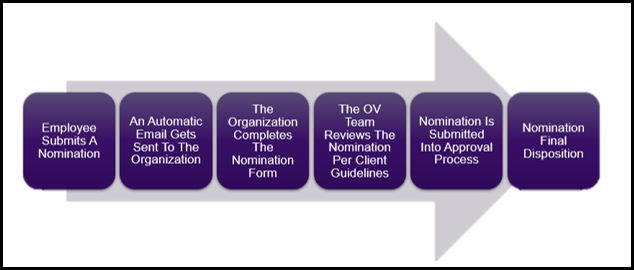
The nomination process is as follows; Employee submits a nomination. An automatic email gets sent to the organization. The organization completes the nomination form. The OV team reviews the nomination per client guidelines. Nomination is submitted into approval process. Nomination final disposition.
Figure 1 - Nomination Process
The timeline for this whole process to be completed is dependent on the responsiveness of the nominated organization and you, if you decide to have a 3-step approval process.
Back to Top
Nomination Review Timeline
Nominations are reviewed either: 1, about 5 business days after the organization completes the nomination form (nominated organization submission date) or 2 about 20 business days after the nomination form is submitted by the employee (creation date).
For nominations where the organization completes the nomination form (nominated organization submission date is not null), if additional information/documentation is required to determine the organization’s tax status and eligibility, outreach is sent via email to the contact on file. The organization has about 20 business days to provide the requested documentation(s). If the organization does not respond to the request for additional documentation(s) after 20+ business days, the nomination will be rejected/not recommended for non-responsiveness.
For nominations where the organization did not complete the nomination form (nominated organization submission date is null), eligibility is reviewed based on the available information/documentation(s). No additional outreach is sent to the organization if additional information/documentation(s) is required. If the organization’s tax status and eligibility cannot be determined with what is available, the nomination will be rejected/not recommended.
| | Nomination Form Completed by the Organization | Nomination Form NOT Completed by the Organization |
| Reviewed | ~ 5 business days after nomination form is submitted by the organization | ~ 20 business days after nomination is submitted by employee |
| Outreach for Additional Info/Docs | Via email to contact on file | n/a |
| Time Organization has to Provide Additional Info/Doc(s) | ~ 20 business days from last communication | n/a |
Figure 2 - Nomination Review timeline
Back to Top
Nomination Approval Process
There are two standard nomination approval processes, a one-step process or a three-step process, depending on whether the nomination needs to be reviewed by you prior to approval or rejection.
One-Step Approval Process
In a one-step process, OV will approve or reject the nomination based on the provided guidelines. You will not be required to review the nominations prior to approval or rejection.
Three-Step Approval Process
In a three-step process, OV will recommend, or do-not-recommend, the nomination based on the provided guidelines in step 1. In step 2, you will need to review the available information and documentation(s) to decide if the nomination is recommended for approval or not. Finally, in step 3, the final disposition of the nomination will be made by OV based on the tax status of the organization and your recommendation from step 2.
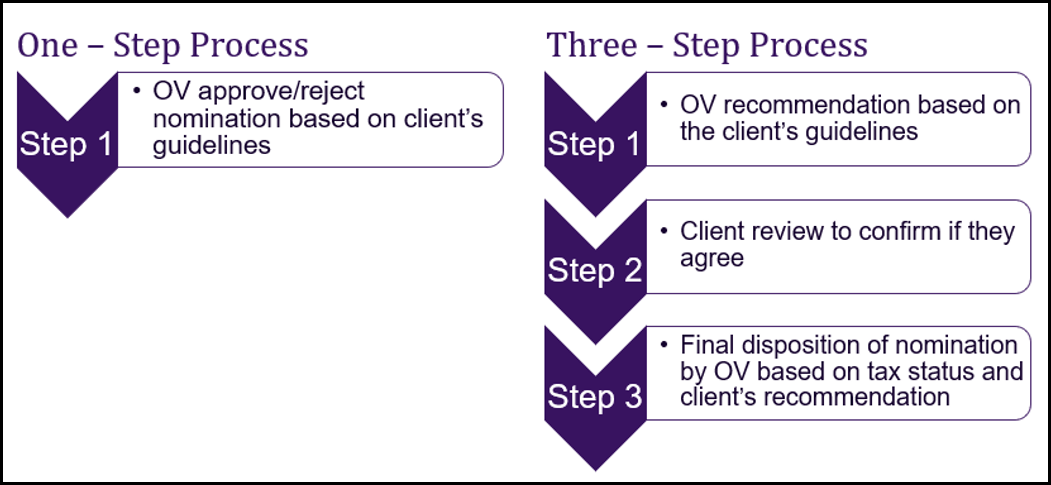
The one-step nomination approval process is as follows: Step 1: OV approve/rejects nomination based on client’s guidelines. The three-step nomination approval process is as follows: Step 1: OV recommendation based on the client’s guidelines. Step 2: client review to confirm if they agree. Step 3: Final disposition of nomination by OV based on tax status and client’s recommendation. o $97.03.
Figure 3 - Standard Nomination approval process
Mapping
If there is already an approved organization record that matches the nomination’s data, the nomination will be mapped to/associated with the existing record rather than going through the full review process again. If there is already an organization record, but the record is not approved, the nomination will need to be reviewed to verify the eligibility of the organization.
Back to Top
Nomination Eligibility Review
The eligibility of an organization is based on the organization’s tax status and the program requirements provided by you. Items that are reviewed include, but are not limited to: tax status, name, address, and the organization’s purpose/mission.
Tax Status
The tax status of the organization needs to be verifiable and acceptable per the program guidelines. Organizations that cannot be verified via a pre-loaded feed will need to be manually verified.
IRS Business Master File – 501(c) Organizations
501(c) organizations are usually listed on the IRS Business Master File (IBMF), unless they were recently granted the status, fell off the file, or have been revoked. Newly established and recently reinstated organizations may not be listed on the IRS data feed or website, as their information may not have been updated in the feed/website. These organizations will need to be manually verified. A copy of their IRS determination letter, or reinstatement letter, would be required. The document should be from within the last 90 days. If not, and the EIN listed in the outdated letter cannot be verified, an updated document would be required to confirm if they are still in good standing.
National Center for Education Statistics – Public & Private K-12 Schools
School districts, public schools, and private schools are usually listed on the National Center for Education Statistics (NCES). If the school or school district cannot be located on the NCES feed, the organization will need to be manually verified. Public schools and school districts are normally governmental entities, while private schools are exempt under their associated church. Proof of the school or the school district's tax status would be required.
Churches
Churches are exempt by default, but most are part of a group exemption, and some do have their own 501(c)3 status. For churches that are part of a group exemption, proof of the parent organization’s tax-exempt status, along with proof that the local church falls under the group exemption, is required. For those that are not part of a group exemption and do not have their own 501(c)3, the church must attest and confirm if they meet the religious purpose test of section 501(c)3 of the Internal Revenue Code and all other applicable IRS guidelines and qualifications. Manuel verification is required for churches that do not have their own 501(c)3.
Governmental Entities
Governmental entities, such as townships and their programs, are exempt under 170(c)1. Written confirmation from the organization affirming if they are recognized as a governmental entity exempt under section 170(c)1 is required. Governmental entities will need to be manually verified.
To learn more about Manual Verification, visit What is Manual Tax Status Verification?
Fire Departments usually fall under two tax statuses:
501(c)4 - Social Welfare Organization
If 501(c)4s are acceptable, the organization’s EIN would be sufficient if the status can be verified via the IRS data feed. If not, a recent copy of the organization’s determination letter would be required.
170(c)1 - Governmental Entity
If 501(c)4s are not acceptable, or if the organization does not have its own 501(c)4 status, and governmental entities are acceptable, a letter, from the organization, on their letterhead, confirming if they are a governmental entity that falls under section 170(c)1 of the IRC would be sufficient.
| | Verifiable via Loaded Feed | Manual Verification Required |
| 501(c)3 Organizations | x | |
| New 501(c)3 Organizations | | x |
| Not listed 501(c)3 Organizations | | x |
| Schools/School Districts | x | |
| Schools not listed on NCES | | x |
| Churches that applied for 501(c)3 | x | |
| Churches under group exemption | | x |
| All other churches | | x |
| Governmental entities | | x |
Figure 4 - Tax status verification
The Organization’s Name
The name of the organization needs to be the same as the name listed with the Internal Revenue Service (IRS), National Center for Education Statistics (NCES), or other provided documentation(s). If the information is different, proof of relationship between the two will be required. Reasons for differences in the organization’s name include, but are not limited to:
Also Known As (AKA)/Doing Business As (DBA)
Many organizations have acronyms or alternate names that are used. Confirmation that the different names are one and the same organization is required.
Name Change
If the organization’s name has changed, but the information has not been updated with the IRS, proof of the organization’s change of name is required.
Departments and Programs
Departments and programs usually fall under the tax exemption of their parent organization unless the department or program applied for its own 501(c)3. Proof that the specific department or program is a valid part of the organization is required.
Sponsorships and Charters
If the nominated organization does not have its own 501(c)3 status but is exempt under another organization that holds a 501(c)3 exemption via a sponsorship or charter relationship, proof of the relationship is required.
The Organization’s Address
The address of the organization needs to be the same as the information listed with the IRS, NCES, or other provided documentation(s). If the information is different, address verification will be required.
Chaptered Organizations
Many organizations with chapters all over the country would have one EIN to cover the exempt status of all its chapters. If the nominated organization is not the parent location, proof that the local address is a valid location/chapter is required.
Address Discrepancy
If the organization is not a chapter, but the address is different, verification of the current address is required. If the organization moves, verification of their new address will be required.
Purpose/Mission
The main purpose of the organization will be reviewed to determine if the organization meets the provided program guidelines.
Documentations
Documentations provided by organizations are required to be dated within the last 2 years. Anything older than 2 years is not sufficient. Updated documentation(s) will be required to confirm if the organization is still in good standing.
Manually Verified Nominations
Manually verified records are valid for 2 years. Organizations will need to be re-nominated after 2 years to reconfirm their eligibility, to confirm their tax status is still valid and in good standing.
Back to Top
Watchlist Scans
If a flag is presented when reviewing a nomination, the flag will need to be reviewed to see if it is a false positive and can be disassociated or if it is an actual match. See Figure 5 – Watchlist Items to Review for some items that are reviewed when trying to disassociate a flag.
| Watchlist Items to Review |
| Scanned Entity | vs | Match Name |
| Address of Organization | vs | Address Listed in Flag |
| Age/Birth Date of Scanned Individual | vs | Age/Birth Date of Flagged Individual |
| Occupation of Scanned Individual | vs | Occupation of Flagged Individual |
Figure 5 - Watchlist Items to Review
Not all items may be available and may not be required if the flag can be disassociated with what is available. Open-source search may be required to obtain additional information required to disassociate or associate, the flag. If required information cannot be located via open-source search, outreach is sent to the organization.
The flag on the nomination can be cleared if the flag can be disassociated. If the flag cannot be disassociated but does not involve a prohibition enforced by the Office of Foreign Assets Control (OFAC), the flag will be sent to you for review, as these flags may be dismissed at your discretion. However, if the flag does involve a prohibition, the flag cannot be cleared, and the nomination cannot be approved. Funds cannot be sent to organizations flagged with a prohibition enforced by OFAC.
Back to Top
Looking for training?
Explore this feature at your own pace - access training video content or watch a recorded webinar by clicking the link below.
Back to Vetting and Screening
Back to Homepage